

Spatial Intelligence
How AI Optimizes Interior Layouts
Ionut-Alexandru Abordeoaei
3/12/20261 min read
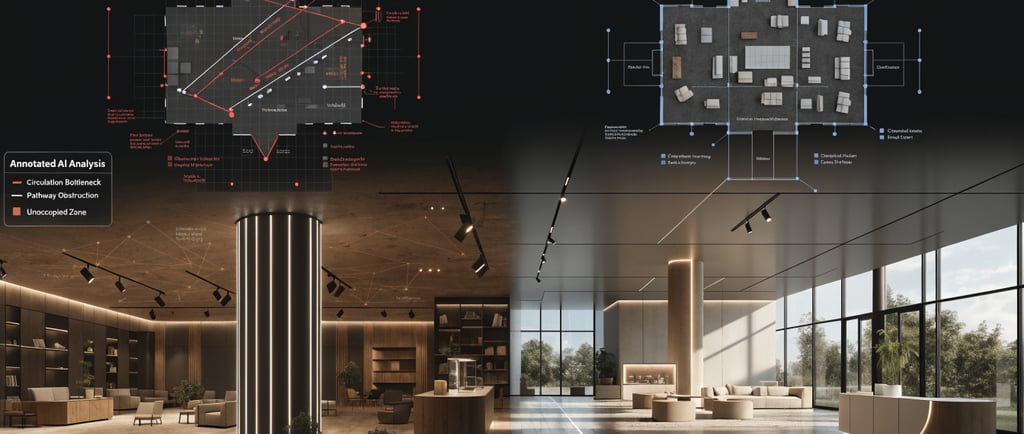
Artificial intelligence is beginning to influence a fundamental aspect of interior design: spatial organization. While concept imagery attracts attention, the real value of AI appears in the analysis of layout efficiency—circulation, functional zoning, and spatial balance.
AI systems can evaluate multiple layout configurations within seconds. By processing parameters such as room dimensions, furniture sizes, movement paths, and functional relationships, algorithms can generate optimized spatial arrangements that respect ergonomic standards and architectural constraints. For residential interiors, this may involve testing kitchen work triangles, furniture clearances, or storage distribution. In commercial environments, it can extend to circulation flow, occupancy density, and operational efficiency.
One of the key advantages is the ability to simulate spatial performance early in the design process. Instead of relying solely on intuition or iterative drafting, designers can test dozens of layout alternatives and immediately identify inefficiencies such as bottlenecks, unused zones, or poor functional relationships between spaces.
However, spatial optimization through AI also has limits. Algorithms prioritize measurable parameters—distance, access, density—but they cannot fully evaluate qualities such as spatial atmosphere, visual hierarchy, or emotional perception of space. A mathematically efficient layout is not necessarily a compelling architectural experience.
For this reason, AI should be considered a decision-support tool rather than a design authority. The designer interprets the data, balances functional optimization with aesthetic composition, and introduces the cultural and experiential dimensions that algorithms cannot quantify.
In practice, the most effective workflow combines computational analysis with human spatial judgment. AI can rapidly test possibilities, while the designer ensures that the final layout serves not only efficiency but also comfort, identity, and architectural coherence.