The culture of home
Rooms with memory: making space for things that stay
A home can be newly furnished and still seem to lack something. Sometimes that missing quality is continuity: an object already ours, a familiar texture, a piece that does not quite match but would be difficult to part with. A personal interior grows around these presences too.
Objects carry different kinds of weight
An inherited chair may take up little space and hold considerable memory. A painting chosen on a journey can matter more than the most expensive piece in the room. That value is not always visible to a visitor. It lives in the relationship between an object and the person who keeps it.
This changes how we think about furnishing. A room becomes a place where different histories coexist, as well as a composition of forms. Some objects deserve prominence. Others can remain close in a quieter corner without losing their importance.
Old and new need a relationship
An older piece does not automatically give a contemporary interior character. If it seems abandoned among unrelated objects, the contrast feels accidental. A relationship might come through a shared line, a colour quietly repeated or a difference in scale that gives the arrangement purpose.
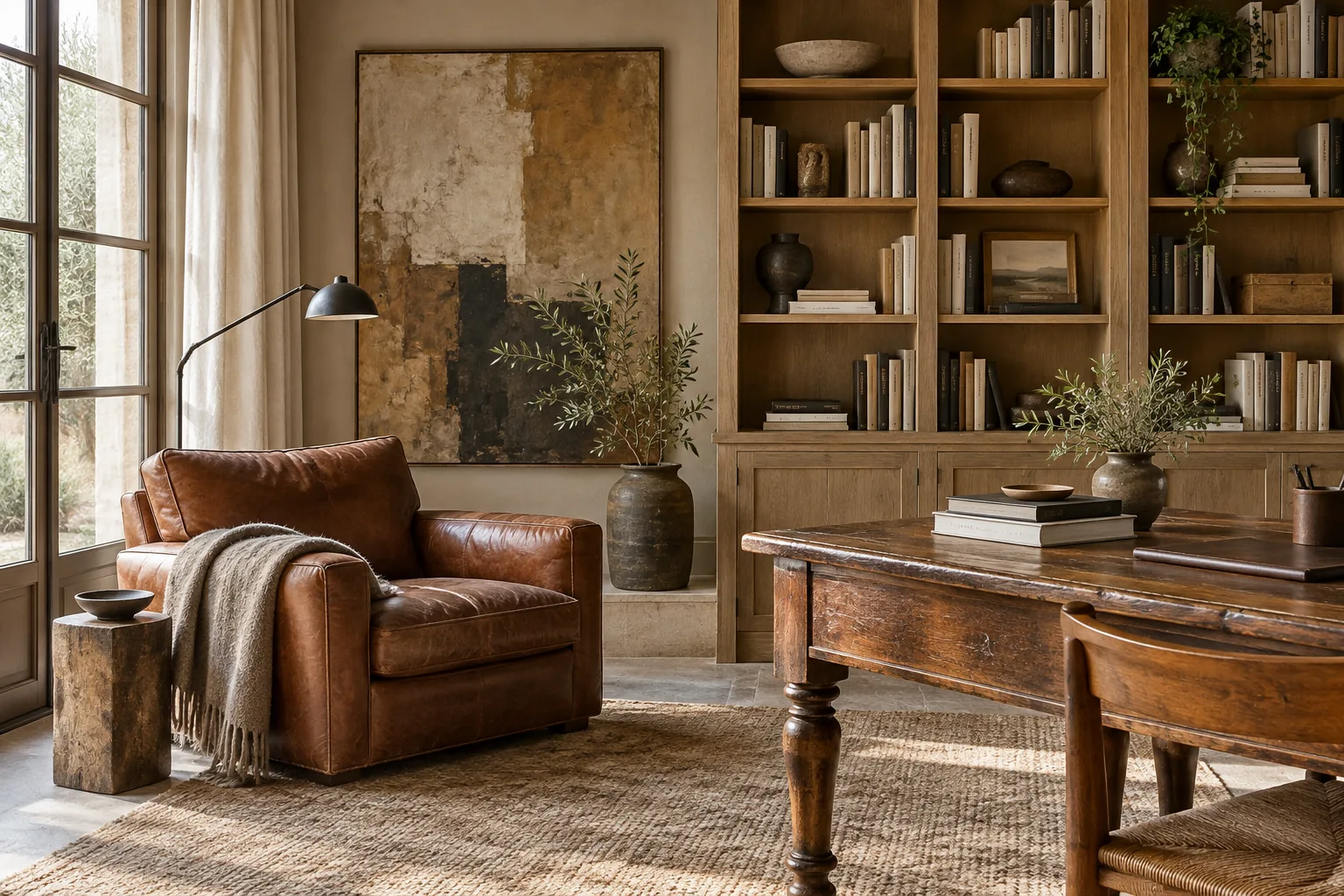
A worn timber desk can sit naturally beside a simple bookcase when the latter offers a calm background. New furniture need not imitate the older piece. A clear distinction between their languages can let each be understood while preserving a shared atmosphere.
A home can grow beyond a matching collection
Rooms bought as a complete ensemble have an immediate coherence. Those gathered over time offer other qualities: surprise, variation and small mismatches that reveal something about their occupants. A graphic lamp beside a soft chair or contemporary art above an old cabinet can create a productive tension.
That freedom still benefits from composition. The rhythm between full and empty, heavy and light, dominant colours and accents helps different things belong together. A simple background can hold a varied collection without erasing its differences.
Signs of time are not compulsory decoration
A worn surface can be beautiful for the story it suggests. Yet a home does not need manufactured patina in every corner. A new object chosen with conviction and used for years can acquire the same familiarity. The memory of a room cannot be purchased all at once.
There is freedom in letting go as well. Keeping everything from obligation can turn a home into storage for the past. A personal interior makes room for significant things without requiring every period of life to remain on display. Continuity also needs space for change.
Leave the room open to what follows
An interior that feels entirely finished may struggle to receive anything new. A bookcase with room for more books, a wall not immediately filled or a piece allowed to find its place later gives the home a chance to evolve.
We are interested in a room coherent enough for the present and flexible enough for what comes next. Its identity need not depend on loyalty to a style label. It emerges from the relationships between objects, habits and time.
Reading the image
The visibly worn desk stands in front of a simple-lined bookcase. Leather and a soft throw add another register of comfort, while the abstract artwork brings the palette together. This is an imagined scene: its objects suggest continuity without being assigned real owners or fabricated histories.